LTL vs FTL Shipping: How to Choose the Right Option for Your Business
What Is LTL Shipping?
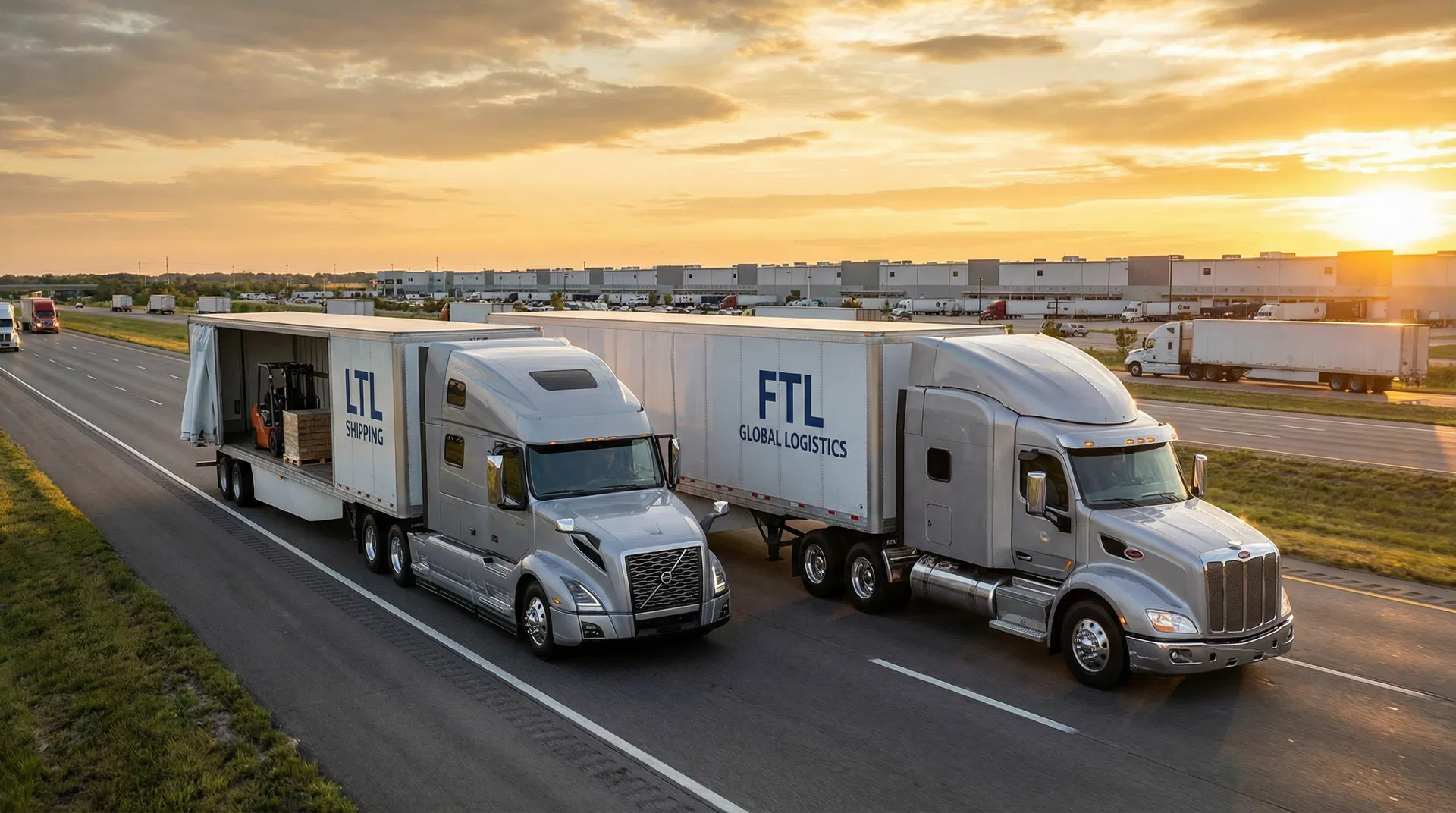
Less Than Truckload shipping is a freight mode designed for shipments that do not fill an entire trailer. In an LTL shipment, your cargo shares trailer space with freight from other shippers. The carrier consolidates multiple smaller shipments going in the same general direction, picks them up from different origins, and delivers them to different destinations along a planned route.
LTL shipments are typically priced based on weight, freight class (a standardized classification system based on density, stowability, handling, and liability), and the distance between origin and destination. Accessorial charges for services like liftgates, residential delivery, and inside pickup add to the base rate.
The defining characteristic of LTL is that you pay only for the trailer space your freight occupies. If your shipment weighs 2,000 pounds and occupies four linear feet of a 53-foot trailer, you pay for those four feet, not the entire trailer. This makes LTL economical for smaller shipments that would cost far more to move as a dedicated truckload.
The tradeoff is that LTL freight typically moves through one or more carrier terminals before reaching its final destination. Each terminal stop involves unloading, sorting, and reloading freight, which extends transit time and introduces additional handling. More handling means a higher risk of damage compared to a direct truckload move.
What Is FTL Shipping?
Full Truckload shipping, also referred to as FTL or simply truckload (TL), dedicates an entire trailer to a single shipper's freight. The driver picks up your load at the origin, and the trailer goes directly to the destination without stops at intermediate terminals. You pay for the full trailer regardless of how much space your freight actually uses.
FTL pricing is typically quoted as a flat rate per load based on the lane (origin and destination), current market conditions, fuel surcharges, and any accessorial services required. Unlike LTL, FTL pricing is not based on freight class or weight (within legal limits), which simplifies the rate structure considerably.
The direct, no-stop nature of FTL shipping produces faster transit times and significantly less cargo handling compared to LTL. A truckload shipment from Los Angeles to Chicago, for example, might transit in two to three days with a single driver, while the same freight moving LTL could take four to six days through multiple terminal transfers.
FTL is the preferred mode for large, heavy, or high-value shipments where transit time and cargo security are priorities. It is also the right choice when a shipper has enough volume to fill or nearly fill a trailer, because the per-unit cost drops substantially as you approach full trailer utilization.
Key Differences: LTL vs FTL at a Glance
| Factor | LTL | FTL |
|---|---|---|
| Shipment size | Typically 1 to 10 pallets or under 15,000 lbs | Typically 10 or more pallets or over 15,000 lbs |
| Pricing basis | Weight, freight class, distance | Flat rate per load, per lane |
| Transit time | Longer (multiple terminal stops) | Faster (direct, point-to-point) |
| Cargo handling | Multiple touches at terminals | Minimal (loaded once, unloaded once) |
| Damage risk | Higher due to multiple handling events | Lower due to direct delivery |
| Cost for small loads | More economical | Expensive (paying for unused space) |
| Cost for large loads | Expensive (multiple LTL rates) | More economical |
| Flexibility | High (book individual shipments as needed) | Lower (requires full load to justify cost) |
| Tracking | Available but less granular | Real-time GPS tracking common |
| Ideal for | Smaller, less time-sensitive shipments | Large, time-sensitive, or high-value loads |
When LTL Is the Right Choice
LTL makes the most economic sense when your shipment is too large for parcel carriers but not large enough to justify a full trailer. The general rule of thumb is that LTL is cost-effective for shipments between 150 and 15,000 pounds, though the right threshold varies by lane, freight class, and carrier pricing.
Beyond weight, LTL is the right choice when your freight is not time-sensitive enough to require the faster transit of a direct truckload move. Many industrial and manufacturing shippers use LTL for replenishment inventory that is ordered well in advance of the need date, giving the carrier enough time to route the freight through its terminal network without creating a service failure.
LTL also works well when you ship frequently but in smaller quantities. A shipper sending three to five pallets to the same region every week can build a reliable LTL program with a preferred carrier, negotiate volume-based rates, and develop a predictable transit time expectation. The key is consistency: LTL carriers reward shippers who provide steady, predictable volume with better rates and service.
One important consideration for LTL is freight class. The National Motor Freight Classification (NMFC) system assigns a class number from 50 to 500 to every type of freight based on its density, stowability, handling requirements, and liability. Higher-class freight is more expensive to ship LTL because it takes up more space relative to its weight or requires special handling. If your freight has a high NMFC class, the LTL rate can become surprisingly expensive, and a truckload move may be more economical even at lower weights.
When FTL Is the Right Choice
FTL becomes the economically superior choice when your shipment is large enough to fill or nearly fill a trailer. A common benchmark is that once a shipment reaches 10 or more standard pallets or approximately 20,000 pounds, the FTL rate is often competitive with or cheaper than the equivalent LTL rate for the same lane.
Time sensitivity is the other major driver of FTL selection. When a customer needs freight delivered by a specific date and the LTL transit time is too long or too variable, a direct truckload move eliminates the uncertainty of terminal transfers. Automotive parts, perishable goods, retail replenishment for peak season, and pharmaceutical products are all examples of freight categories where transit time reliability justifies the cost of a dedicated trailer.
Cargo security is a third factor that pushes shippers toward FTL. High-value freight, fragile goods, and products that require specific handling conditions (temperature, humidity, orientation) are better suited to FTL because the freight is loaded once and not touched again until it reaches the destination. Every terminal transfer in an LTL move is an opportunity for damage, theft, or misrouting.
The Gray Zone: Partial Truckload (PTL)
Between LTL and FTL lies a third option that many shippers overlook: Partial Truckload (PTL), sometimes called volume LTL or spot LTL. PTL is designed for shipments in the 5,000 to 20,000 pound range that are too large for standard LTL pricing but do not fill a full trailer.
In a PTL shipment, a carrier may combine your freight with one or two other shippers' loads going in the same direction, but the freight moves with fewer terminal stops than standard LTL. The result is faster transit times and less handling than LTL, at a lower cost than a dedicated FTL move.
PAC Runners works with shippers to identify lanes where PTL can deliver meaningful cost savings compared to standard LTL, particularly on longer-haul lanes where the transit time advantage of fewer terminal stops is most pronounced.
Cost Comparison: LTL vs FTL by Shipment Size
To make the LTL vs FTL decision concrete, consider a sample shipment from Los Angeles to Dallas. The following estimates are illustrative and based on typical market rates; actual rates vary by carrier, season, and market conditions.
| Shipment Size | LTL Estimated Cost | FTL Estimated Cost | Better Option |
|---|---|---|---|
| 2 pallets (1,500 lbs) | $350 to $550 | $2,200 to $2,800 | LTL |
| 5 pallets (4,000 lbs) | $700 to $1,100 | $2,200 to $2,800 | LTL |
| 8 pallets (8,000 lbs) | $1,400 to $2,200 | $2,200 to $2,800 | LTL or PTL |
| 12 pallets (14,000 lbs) | $2,400 to $3,800 | $2,200 to $2,800 | FTL |
| 20 pallets (24,000 lbs) | $4,000 to $6,000+ | $2,400 to $3,000 | FTL |
The crossover point where FTL becomes more economical than LTL typically falls somewhere between 10 and 14 pallets for a standard lane. The exact crossover depends on freight class, lane distance, and current market rates. Shippers near this threshold should get quotes for both modes before booking.
How Freight Class Affects the LTL Decision
Freight class is one of the most misunderstood aspects of LTL pricing, and it is a common source of unexpected cost increases. The NMFC system assigns class numbers based on four factors: density (weight per cubic foot), stowability (how easily the freight can be loaded with other goods), handling (special equipment or care required), and liability (value and damage risk).
Lower freight classes (50 to 100) represent dense, easy-to-handle freight like machinery parts, building materials, and packaged food. These classes carry the lowest LTL rates. Higher freight classes (125 to 500) represent lighter, bulkier, or more fragile freight like furniture, electronics, and certain chemicals. These classes carry significantly higher rates.
A shipper who misclassifies freight at a lower class than the NMFC assigns will receive a freight bill correction from the carrier after delivery, often adding hundreds of dollars to the invoice. Accurate freight classification is not optional; it is a basic requirement for managing LTL costs effectively.
Transit Time and Service Level Considerations
Transit time is one of the most significant practical differences between LTL and FTL, and it deserves careful attention when choosing a shipping mode.
LTL transit times are longer and more variable because freight moves through a hub-and-spoke network of carrier terminals. A standard LTL shipment from the West Coast to the East Coast might take five to seven business days, with the actual delivery date depending on which terminals the freight passes through and how efficiently each transfer is executed.
FTL transit times are faster and more predictable because the driver goes directly from origin to destination. A coast-to-coast truckload move typically takes three to four days with a single driver, or two to three days with a team of two drivers.
For shippers with strict delivery windows, such as retail vendors with Must Arrive By Date (MABD) requirements or manufacturers with just-in-time production schedules, the reliability of FTL transit is often worth the premium over LTL. A missed delivery window in retail can result in chargebacks that dwarf the cost difference between LTL and FTL.
Building a Mixed-Mode Freight Strategy
The most cost-effective freight programs do not rely exclusively on LTL or FTL. They use a mixed-mode strategy that routes each shipment through the most appropriate mode based on its specific characteristics.
The starting point is a lane-by-lane analysis of your freight profile. For each significant lane, calculate the average shipment size, frequency, freight class, and transit time requirement. Use these inputs to determine the optimal mode for each lane. High-volume lanes with large shipments are candidates for FTL contracts. Lower-volume lanes with smaller, less time-sensitive shipments are candidates for LTL.
Review your mode assignments quarterly. Freight profiles change as your business grows, product lines evolve, and customer locations shift. A lane that made sense for LTL six months ago may now justify an FTL contract if volume has grown. Regular review ensures your freight program stays optimized as conditions change.
Frequently Asked Questions
What is the weight threshold where FTL becomes cheaper than LTL?
The crossover point varies by lane, freight class, and market conditions, but a common benchmark is around 10,000 to 15,000 pounds or 10 to 14 standard pallets. Always get quotes for both modes when your shipment falls in this range, as the difference can be significant in either direction depending on current market rates.
Does LTL or FTL have better tracking?
FTL shipments generally offer better real-time tracking because the load stays on a single truck from pickup to delivery. Most FTL carriers provide GPS-based tracking with live location updates. LTL tracking is available but less granular, with status updates typically provided at each terminal scan rather than continuous location data.
Can I ship hazardous materials via LTL?
Yes, but with significant restrictions. Hazardous materials shipments must comply with DOT regulations regardless of mode, but LTL carriers have varying policies on which hazmat classes they will accept. FTL is often the more practical option for hazmat shipments because you can select a carrier with the appropriate certifications and equipment for your specific material.
How does freight class affect my LTL rate?
Freight class directly determines the per-hundredweight (CWT) rate applied to your LTL shipment. Higher freight classes carry higher rates because the freight is less dense, harder to handle, or carries greater liability. Accurate classification is essential for budget accuracy, and misclassification can result in significant freight bill corrections after delivery.
What is the difference between LTL and parcel shipping?
Parcel shipping (via UPS, FedEx, or USPS) is designed for individual packages under 150 pounds. LTL is designed for larger shipments, typically palletized freight between 150 and 15,000 pounds. For most business freight that is palletized or exceeds 150 pounds, LTL is the appropriate mode.
How do I get the best LTL rates?
The most effective strategies for reducing LTL rates are: consolidating shipments to increase weight per bill of lading, accurately classifying freight to avoid reclassification charges, negotiating volume-based discounts with a primary LTL carrier, auditing freight invoices for billing errors, and working with a 3PL that has negotiated volume discounts across multiple carriers.
Stay Updated
Get the latest logistics insights, industry trends, and supply chain tips delivered to your inbox.
We respect your privacy. Unsubscribe at any time.